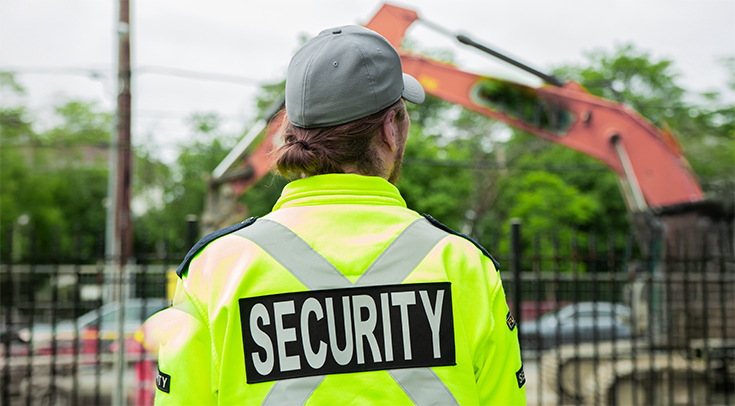
Scottish fire safety legislation is being strengthened. Duty holders face expanding obligations under the Fire (Scotland) Act 2005, and from April 2026, new building regulations extend cladding restrictions to hotels, hostels and guest houses. Thousands of residential buildings are already in scope for Single Building Assessments. If you’re responsible for non-domestic or high-rise residential premises in Scotland, not taking action is no longer an option.
Triton Security delivers fire safety services across Scotland. From alarm systems and round-the-clock monitoring, through to trained fire wardens and Waking Watch. We hold SIA Approved Contractor Scheme (ACS) status and work to ISO 9001, 14001 and 45001 standards. Every service is documented, supervised and built around the building’s actual risk profile.
Fire Safety Services for Scotland Businesses
A Victorian-conversion hotel in Edinburgh needs a different fire strategy to a 1970s residential tower in Glasgow or a modern student block in Dundee. We work across all of them, designing each engagement around building type, occupancy and what the fire risk assessment demands.
The premises we cover with fire safety in Scotland include:
- High-rise and mid-rise residential blocks
- Hotels, guest houses, hostels and serviced accommodation
- Student halls and university buildings across Glasgow, Edinburgh, Aberdeen, Dundee and St Andrews
- Offices, retail units and mixed-use developments in city centres and business parks
- Healthcare premises, schools, care homes and public-sector buildings
- Active construction sites and buildings mid-refurbishment where permanent controls are not yet operational
Fire Alarm Systems Designed for Occupied Scottish Buildings
Most alarm installations in Scotland happen while people are still living, working or sleeping in the building. That affects everything about how we plan the work, from access windows and noise disruption, through to services and phasing around building routines.
We handle new installations, upgrades to legacy systems, and temporary arrangements for buildings partway through remediation or conversion. Everything is specified in line with BS 5839-1 where applicable.
How the right alarm system supports your duties
Under the Fire (Scotland) Act 2005, duty holders must take measures to ensure the safety of people in and around their premises. A well-specified alarm system helps you meet those duties by:
- Picking up smoke or heat early enough for occupants to evacuate safely
- Giving clear, audible warnings across every part of the building
- Producing the activation records the SFRS will expect to see if they inspect your premises
- Satisfying insurer requirements and reducing the risk of a policy dispute after an incident
- Aligning with whatever the fire risk assessment has identified as necessary for the building’s specific layout and use
Choosing Between Wired, Wireless and Hybrid Systems
Choosing a system type should be a practical decision not influenced by preference. The building’s construction, whether it’s occupied during installation, and how it might change over the coming years are what influence that decision.
Hard-wired systems
These systems are best suited to new builds and major refurbishments where cabling routes are open and accessible. Hard-wired systems are reliable over long timeframes and straightforward to service, making them a practical choice for larger commercial or residential buildings going through a full construction programme.
Wireless systems
Scotland has a large stock of listed, traditional and stone-built properties where running cables is either impractical or prohibited by conservation rules. Wireless systems go in faster, with less disruption, and avoid unnecessary structural interference. They also suit retrofit projects in occupied residential blocks where minimising intrusion is a priority.
Hybrid systems
When a building has some areas that can be hard-wired and others that can’t, a hybrid approach lets you use the right technology in each zone. It also allows phased upgrades without ripping out what already works.
24/7 Monitoring and Incident Escalation
An alarm that nobody responds to is just noise. We provide round-the-clock monitoring for premises across Scotland where a missed signal could put lives at risk or leave the duty holder exposed.
Before monitoring goes live, we agree exactly what happens when an activation comes through: who gets notified, in what order, and at what point the SFRS is called. That removes ambiguity.
Monitored fire safety gives duty holders in Scotland:
- Rapid escalation of confirmed incidents
- Overnight and weekend coverage that doesn’t rely on a keyholder
- Timestamped records of every activation and response
- Confidence for occupants, building managers and insurers that someone is always watching
On-Site Fire Wardens and Waking Watch in Scotland
In buildings where fire risk is high enough to warrant a physical presence (because of occupancy, layout or impaired detection) we place trained personnel on-site to patrol, observe and respond.
Fire warden cover
Our fire wardens carry out structured patrols across shared and high-risk areas. They are trained to spot the hazards that cause fires. That means checking:
- Fire doors are closing fully and haven’t been wedged open
- Escape routes and stairwells are clear of storage, waste and obstructions
- Emergency lighting and signage are visible and functional
- Any newly introduced risks are flagged and logged
Warden cover runs on a temporary or ongoing basis depending on the building’s needs. We report findings directly to whoever holds the fire safety responsibility.
Waking Watch across Scotland
Since the Housing (Cladding Remediation) (Scotland) Act 2024 came into force, thousands of residential buildings over 11 metres are being assessed for cladding risk. Many of those buildings will need interim fire safety measures while permanent remediation is completed. Waking Watch fills that gap.
We deploy dedicated wardens to patrol continuously through agreed routes, focused entirely on fire detection and raising the alarm manually if needed. Patrol frequencies, escalation procedures and reporting are all agreed with the duty holder in advance and aligned to the building’s layout.
As buildings move towards permanent alarm systems, we manage the transition so that Waking Watch scales down in step with the new detection going live. The aim is always to get to a position where patrols are no longer needed, and to make that transition safely.
End-to-End Fire and Safety Management
An alarm installed by one company, monitored by another, and supported by wardens from a third means nobody owns the full picture. We run fire safety services in Scotland as a single managed operation from initial review through to ongoing maintenance and support.
That typically includes:
- A review of the building and its current fire safety position
- Specifying what’s needed based on use, occupancy and risk assessment findings
- Installing or upgrading systems while the building stays operational
- Commissioning and sign-off before anything goes live
- Scheduled maintenance, monitoring and technical support for as long as the contract runs
Systems can be purchased outright or leased, so cost doesn’t delay getting the right protection in place.
Why Scottish Duty Holders Choose Triton
Fire safety in Scotland comes with its own legislation, its own enforcing authority and its own building standards system. A provider working from an England-and-Wales playbook will miss those differences. We don’t.
Clients across Scotland work with us because we:
- Know the Fire (Scotland) Act 2005 and the regulations that sit underneath it
- Work around occupied, operational buildings without shutting down floors or displacing tenants
- Bring teams experienced in high-rise residential, hospitality, student accommodation and complex mixed-use sites
- Handle both short-term deployments and long-term managed contracts
- Combine fire protection with wider site security under one contract where both are needed
One provider. One point of contact. One team accountable for fire and safety across your Scottish sites.